
Visibility Intelligence for search and AI answers.
Ads can bring customers in fast. But when you stop paying, that traffic often stops too. Create a free verified account to see how well your page is set up to be understood by search engines and AI systems — with specific fixes and no ranking promises.
Visibility is ultimately about business opportunity.
SEO, GEO and AEO influence how easily people can discover, understand and evaluate your business across traditional search and AI-driven experiences.
Better visibility can bring more relevant people to your website, or put your business in front of them while they are researching a problem, product or service. That creates more opportunities for those people to explore your offer, make an enquiry, sign up or buy.
Better visibility → more relevant discovery → more qualified traffic and attention → more opportunities for leads and sales
The audit reviews the page conditions that can support that path across SEO, GEO and AEO. It does not predict rankings, traffic or revenue, because those outcomes also depend on factors such as demand, competition, your offer, pricing and conversion experience.
Try it on your own page
Enter a public URL to see what the page does well and what to fix.
What are the four visibility questions? One page answers all four.
One URL in. Three diagnostic engines plus an access check out. By Grady Coleman (Founder) · Last updated: .
Does the page support search discovery and interpretation?
The SEO lens reviews 18 on-page checks - titles, meta descriptions, headings, canonicals, robots directives, snippet eligibility, links, and alt text. Each check reports a condition found on the page, not a ranking position. According to Google's SEO Starter Guide, these are the underlying fundamentals that support search discovery.
Does the page provide the signals generative systems can understand and reuse?
Research indicates yes. The GEO lens reviews 11 readiness checks - answer blocks, question headings, fact density, entities, freshness, and citations. According to Google's 2026 guidance, no special AI markup is required. These are research heuristics, not Google requirements, and not a promise of AI inclusion.
Can the content answer questions clearly and extractably?
Yes, and it can be improved. AEO Readiness reviews 17 answer-readiness checks - visible Q&A, question headings, direct answer blocks, key takeaways, references, and content depth. A strong answer opens with the conclusion under a question heading, then supports it with specifics. It is Beta because readiness never predicts what an answer engine will select.
Can relevant automated systems actually access the site?
The crawler lens reviews robots.txt directives per major search and AI crawler for the path you check - reported as allowed, blocked, or not evaluated, never as a score. Permission is not proof of a visit, indexing, citation, or recommendation.
| Lens | Checks | What the review looks at |
|---|---|---|
| SEO | 18 | Titles, structure, canonicals, links, and other search foundations |
| GEO | 11 | Entities, sources, freshness, and useful page context |
| AEO · Beta | 17 | Question structure, direct answers, and content depth |
Crawler access for 9 identities is reviewed separately from the 46 scored checks.
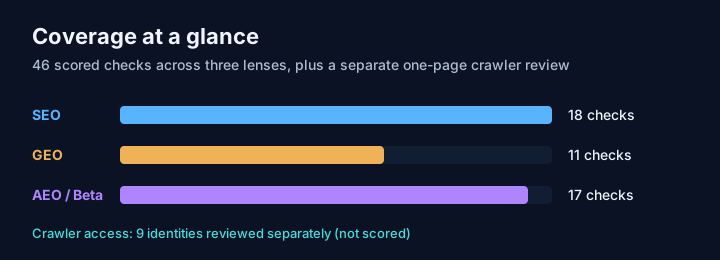
The audit is directional, not predictive.It reports conditions, not outcomes. None of these 46 checks promises ranking, indexing, traffic, AI Overview inclusion, or citations, because each engine weighs signals differently and changes over time. According to Google's published guidance, no special markup guarantees AI inclusion either. Use the audit as a prioritized fix list. Read the full methodology.
Ready for your own page?
Run the full visibility audit after creating a free verified account. No credit card required.
Four signals, one honest read. No invented numbers.
Every value in the scan above comes from the live audit engine. Pending cards show nothing until real data arrives.
Search
SEO surface · 18 checks
On-page fundamentals search engines read: titles, meta descriptions, headings, canonicals, structured data, internal links, and alt text.
Answers
AEO readiness · Beta · 17 checks
How answerable the content is: FAQPage schema, question headings, direct answer blocks, key takeaways, references, and content depth.
AI Search
GEO surface · 11 checks
Generative-engine readiness: self-contained answer blocks, fact density, named entities, freshness signals, author attribution, and citations.
Crawlers
machine access
Whether search and AI crawlers can actually reach the site: robots directives and crawler path access, reported as open paths — not a score.
What does the scan not promise?
No. According to the product design, no tool can guarantee ranking, indexing, traffic, AI Overview inclusion, or citations, because each engine weighs signals differently and changes over time. Use the scan as a prioritized fix list. Read the full methodology →
How do agencies and consultants use it?
Run the free snapshot to qualify a client site, then choose the Agency plan for 250 checks and multi-client organization. Compare agency plans →
What does crawler access check? Access is not content.
Content checks the page; access checks what the site allows. Optimus keeps them separate.
How is crawler access separate from SEO, GEO, and AEO?
The three content scores measure what the page says. Crawler access measures whether your site's robots.txt lets search and AI systems in — evaluated per crawler, for the path you check. A page can be content-ready and still unreachable. Page-level noindex (meta robots) is covered by the SEO checks.
What are the three crawler states?
Every crawler is reported as Allowed, Blocked, or Not evaluated. If the evidence is missing — for example no robots.txt — the result is not evaluated, not a guess.
What does crawler access not tell you?
It does not observe crawler visits, indexing, or AI ingestion. Those are different questions that require different evidence — we will not pretend otherwise.
SearchTrainingAds
The honesty strip: a missing robots.txt does not prove crawlers visited. An open path is a permission, not a promise. Crawler access is reported as configuration evidence — open or blocked paths, with the reason — never as a score and never as observed activity.
How does a score become a finding? A finding tells you what to do.
Every result walks the same path — here is one real example from Optimus Pass's public self-audit.
Finding
What we found: blog pages lack visible FAQ sections and question headings, so an answer engine has little to lift even when the article has real depth.
Evidence
According to the page evidence, the articles contain substance, but they are not structured for answer extraction - no visible Q&A block and no question-form H2 to anchor a direct answer.
Why it matters
Why it matters: answer-ready structure is exactly what the AEO checks measure. According to AEO research, content that opens with the conclusion under a question heading is easier for an answer system to extract and attribute than a long narrative.
Recommendation
The recommended fix is to add visible Q&A sections and question-formatted H2s to the articles, each opening with a direct 40 to 160 word answer before the detail.
Next action
The next action: in a full report this appears as one of many per-check findings - each with a status, an owner, and a specific fix, so you know exactly what to work on first.
Workflow example from the public self-audit report — sample presentation of the report structure, not a live scan of your site.
Every material finding carries
A score without evidence is a guess. A finding with evidence, status, interpretation, and an owner is a fix list. Full evidence contract on the methodology page.
What is in the report? The score is just the summary.
What the value actually consists of — verified functionality, not marketing.
- Per-check findings across SEO, GEO, and AEO — Beta, each with status and fix
- Observed evidence behind material findings — not just a number
- Crawler intelligence where the site supplies the evidence
- A saved, reopenable report for paid plans — re-runnable on request
- The executive path — a human-reviewed, client-ready report when you need it
Figures on those example pages are static demonstration values, not a live audit — the same distinction every real report makes between observed evidence and sample data.
Why is one audit the baseline? Repeated audits show what changed.
Optimus is not merely a scanner — the workflow is the point.
Baseline
The baseline is the first audit. It defines what is working and what is not - with the evidence behind each finding, not just a number.
Improve
The improvement step is to fix the highest-value findings from the report, starting with the three Fix First priorities so effort goes where it matters.
Re-scan
A re-scan runs the same URL again. According to the product design, paid plans can re-run saved audits so the comparison is apples to apples.
Compare
The comparison shows what resolved, what is newly open, and how the score moved since the previous audit - matched by the engine-reported check name.
Next priority
The next priority is what the new report tells you to work on next - so the workflow ends with a decision, not just a position.
What is real, what is not: persisted audits, per-account history, re-runs of saved audits, and the measured-change readout in each new report are live capabilities on paid plans. Optimus does not run scheduled or automatic monitoring, and no re-scan promises rankings, citations, or traffic. According to the product design, a re-scan runs the same URL against the same checks and shows what changed in the evidence, matched by the engine-reported check name.
Self-serve
Do you want visibility intelligence on your own schedule?
- Free snapshot: four signals on one domain, verified account required
- Professional / Agency: full per-check findings with fixes
- Saved reports, history, and re-runs of saved audits
See plans for saved reports, full findings, and re-runs.
Software plans
Do you need software for one brand or many clients?
- Saved reports and full visibility diagnostics
- Re-runs of saved audits when you choose to run them
- Agency workflow on the Agency plan
What else is worth reading?
AI Visibility Reports You Can Defend
The contrast matters: most AI visibility reports present a single proprietary score with no traceable basis, while a defensible report ties every finding to evidence you can re-check and labels verified versus heuristic signals.
Rankings Are High but Traffic Is Falling
Rankings, impressions, and clicks are three different measurements. A 2026 diagnosis path for falling traffic on stable rankings — and what to actually do about it.
Running ads to this page?
Scan the ad copy before submission. The ad-copy compliance check and this page audit are separate reviews.
Frequently asked questions about visibility
What is Optimus Pass Visibility?+
Who is it for — and who is it not for?+
What is the difference between the free snapshot and a paid plan?+
Which software plan should I choose?+
Will a high score make AI systems cite my site?+
Sources and references for these checks
The references below are public documentation or research, cited so the method is verifiable rather than asserted. According to Google's published guidance and OpenAI's crawler documentation, no special markup is required for AI features. A reference is not an endorsement of Optimus Pass and does not validate any readiness score.
- Google SEO Starter Guide
- Google: AI features and your website
- Google Structured Data: Article
- FTC Advertising & Marketing Guidance
- W3C Web Content Accessibility Guidelines (WCAG) 2.2
- Stanford University: search and information-retrieval research
- DOI: Survey of hallucination in natural language generation (ACM Computing Surveys, 2023)