
Skip to content
Free snapshot · verified account · no card

Run one page through the review.

See what search engines and AI systems can work with, what evidence is missing, and which fix deserves attention first.

Primary visibility diagnostic · verified account required · no credit card

By · Last updated:

Summary

Key takeaways: what do you get from one scan?

  • Run one public page and get directional SEO, GEO, and AEO readiness scores in a single pass.
  • Every finding shows what was observed, why it may matter, and a specific change to make next.
  • 46 scored checks across SEO (18), GEO (11), and AEO (17, Beta), plus a separate review of 9 crawler identities.
  • Findings describe the page's readiness signals, not rankings, traffic, or AI citations.

From score to fix

How does the score become a next move?

The scan turns a directional score into a short, ordered fix list. According to the engine design, the score summarizes 46 observed conditions across SEO, GEO, and AEO checks, and the value is in the findings behind it, not the number itself. The four steps below describe how a raw page condition becomes a specific task your team can implement and re-check.

  1. 01 / Observe

    What does the page contain?

    The page is inspected for directly observable conditions. According to the engine, the SEO lens reports 18 page-level signals, the GEO lens reports 11 readiness signals, and the AEO lens reports 17 answer-readiness signals, each as a condition found on the page rather than a ranking position.

  2. 02 / Interpret

    Why does it matter?

    The distinction matters because observed signals and heuristic guidance are not the same thing. According to the engine, a missing title is an observed condition with a documented effect, while the 40 percent question-heading target is a research heuristic drawn from GEO studies. The report labels which is which, so no finding is shown without its reason.

  3. 03 / Fix

    What should you change next?

    The change is specified as a concrete implementation task. According to the finding, each fix names the element to update and the reason it matters, with the matched evidence attached. The implementer does not have to reconstruct the diagnosis from a score, which is the whole point of a 2026 fix list.

  4. 04 / Re-scan

    What changed after the fix?

    According to the re-scan, the comparison shows what changed on the page. Checks are matched by their engine-reported name, so a re-run shows exactly what resolved, what is newly open, and how each of the 46 conditions moved since the previous audit. The fix is only closed when the page itself changes.

What the lenses ask

What are the four readiness questions?

01 / SEO

Can search engines understand the page?

Yes. Search engines can understand the page: the SEO lens reviews 18 page-level checks across titles, meta descriptions, headings, canonicals, robots directives, snippet eligibility, internal links, and image alt text. It describes conditions found on the page, not a ranking position. Google's SEO Starter Guide documents the underlying fundamentals.
02 / GEO

Is there substance for AI systems to reference?

Research indicates yes. The GEO lens reviews 11 readiness checks for answer blocks, question headings, fact density, freshness, citations, and multi-modal content. According to Google's 2026 guidance on AI features, no special AI markup is required. These are directional diagnostics of what the page exposes, not measured AI citations and not a promise of inclusion in any AI answer.

03 / AEO · Beta

Can the content answer a question clearly?

Yes, and it can be improved. AEO Readiness — Beta reviews 17 answer-oriented signals, including question structure, direct answers, key takeaways, author attribution, and content depth. A strong content answer opens with the conclusion under a question heading, then supports it with specifics. AEO stays Beta because readiness is not a prediction of what an answer engine will select, and coverage of 17 checks is not a guarantee of inclusion.

04 / Crawlers

Can automated systems access the site?

Yes. Automated systems can access the site: the crawler lens reviews configuration for 9 identities separately from the 46 scored checks. On this page no blocking directive was detected, but permission is not proof of a visit, indexing, ingestion, ranking, or citation. See OpenAI's crawler documentation for an example of provider-specific controls.

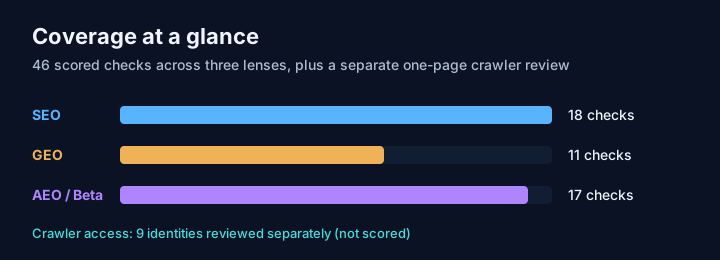
Coverage at a glance
LensChecksWhat the review looks at
SEO18Titles, structure, canonicals, links, and other search foundations
GEO11Entities, sources, freshness, and useful page context
AEO · Beta17Question structure, direct answers, and content depth

Crawler access for 9 identities is reviewed separately from the 46 scored checks.

Bar chart of Optimus Pass audit coverage: 18 SEO checks, 11 GEO checks, and 17 AEO Beta checks, plus 9 crawler identities reviewed separately

The result is a fix list

How does a finding become an inspectable fix?

SEO / METADATAIllustrative example · not a live scan

What does a missing page title look like?

The finding shows a page condition anyone can verify by viewing the page source. Missing metadata, empty headings, and absent canonical tags all fall in this class. No customer result or readiness score appears here.

01 / Evidence<head>
  <title></title>
</head>

The title element contains no text.

02 / Why it matters

A descriptive title communicates the page subject to search engines and readers alike. An empty title leaves that page-level signal unavailable for discovery. The gap says nothing about rankings, which depend on hundreds of separate signals.

03 / Recommended fix

Add a concise title that reflects the actual page content, then confirm the title in the rendered HTML after publishing. Re-run the same URL to verify the fix. The finding closes only when the page itself changes.

What this scan does not claim

What does the audit not promise?

The readiness audit is distinct from a rank tracker or a monitoring suite. A rank tracker measures positions versus competitors over time; this audit measures on-page readiness at a point in time. If you need positions or ongoing monitoring, this is the wrong tool.

Not rank trackingNot traffic measurementNot citation monitoringNot a whole-site crawlNo visibility guarantee

Choose the next level

What happens after the snapshot?

Self-serve

Do you want to work from the findings yourself?

Save reports, review findings, and re-run when you are ready.

Explore plans

Done-for-you

Would you rather have it reviewed for you?

One-time $1,995. Full review, prioritized fix plan with grouped tasks and completion checks, plus one re-scan of up to three URLs.

See the audit service

Common questions

Frequently asked questions about the audit

What does the visibility audit check?+

The audit runs three diagnostics on the URL you submit. SEO covers 18 on-page checks including title tags, meta descriptions, headings, canonical tags, robots directives, snippet eligibility, internal links, and image alt text. GEO covers 11 AI Overview readiness checks such as answer blocks, question headings, fact density, freshness, and citations. AEO Readiness — Beta covers 17 answer-readiness checks including visible Q&A content, author bylines, key takeaways, and content depth. Results are directional diagnostics, not guarantees of ranking, indexing, or AI citation.

How should I read the SEO, GEO, and AEO scores?+

Each score is a directional 0-100 summary of that dimension's check results. A higher score means the page shows more of the measured readiness signals for that dimension. A lower score points to specific fixes listed in the findings. Scores are directional: they describe the evidence on the page, not how a search engine or AI system will actually rank, index, or cite it.

Is the audit free?+

The limited visibility snapshot runs on a supported public page with a free verified account. It shows directional scores and top issue categories. Private, blocked, or inaccessible pages may not be analyzable. See /pricing for Free, Professional, and Agency terms; Agency Pro is coming soon.

What does the audit not guarantee?+

No audit can guarantee ranking, indexing, traffic, AI Overview inclusion, or citations. Search engines and AI systems change constantly, and each one weighs signals differently. Use the audit to prioritize fixes, not as a promise of results.

Verifiable sources

Sources and references for these checks

The references below are public documentation or guidance, referenced so the method is verifiable rather than asserted. According to Google's published guidance and OpenAI's crawler documentation, no special markup is required for AI features. A reference is not an endorsement of Optimus Pass and does not validate any readiness score.