
Test Your Ad Before You Spend
Check your ad copy against 65 risk detectors across 10 platforms before launching. Get safer wording suggestions and compliance risk insights instantly.
By Grady Coleman (Founder) · Last updated:
What should you know first? Key takeaways
- Review ad copy against 65 risk detectors and 10 platform profiles before launching any campaign.
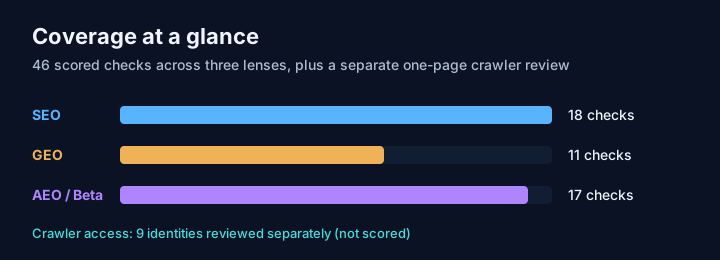
- Check the destination page separately with the visibility audit across 46 SEO, GEO, and AEO checks.
- Every finding cites the matched wording with severity and a lower-risk rewrite where one exists.
- A clear review means fewer known risks, never a guarantee of approval or performance.
How does the review work?
Paste ad copy
Enter your ad copy and select the platform.
Select platform
Meta, Google, TikTok, LinkedIn, and more.
Get compliance risk score
See flagged terms, narrative patterns, and safer rewrite suggestions.
Take action
Upgrade for more checks, or review your campaign portfolio.
Where should you start?
Scan Ad Copy
Verified free account required — no credit card. Checks copy against all 65 risk detectors across 10 platforms.
Start ScanVisibility Audit
SEO, GEO, and AEO readiness analysis for your site. Get a complete visibility report with AI crawler intelligence.
Run AuditWhich plan fits a campaign review?
Free: 3 verified-account checks. Professional: 50 checks with landing-page and visibility diagnostics for $199/month. Agency: 250 checks with multi-client organization for $599/month.
View PlansWhat do people ask before they launch?
How does a campaign review work?+
According to the product design, a campaign review starts when you paste ad copy and select the platform profile you plan to run on. The engine runs 65 risk detectors over the text, groups every match by severity, and shows the exact phrase that triggered each finding with a lower-risk rewrite where a responsible alternative exists. The whole review completes in seconds, and authenticated scans save the report to your account.
What should you review before launching a campaign?+
According to the review workflow, check the ad copy first, then the destination page. The ad scanner reads the wording against 65 detectors and 10 platform profiles, while the visibility audit reads one public URL against 46 SEO, GEO, and AEO checks. Platforms weigh copy, landing pages, and account history together, so reviewing only one of the two leaves known risks on the table.
How is this different from boosting a post and hoping?+
According to the product positioning, boosting without review means the first feedback comes from the platform in the form of a rejection or restriction. A pre-launch review surfaces the wording most likely to trigger that outcome while editing is still free. Compared with learning from rejections, which costs time, budget, and account standing, a scan costs one of 3 free lifetime checks or a fraction of a paid plan.
Does a clear review guarantee the campaign will run?+
No. According to the product terms, Optimus Pass is a review aid that lists known risks with evidence; it does not predict or guarantee platform approval, ranking, or performance. A clear result means the 65 detectors found fewer known risks, nothing more. Review each flag against the cited platform policy before submitting, and use the platform appeal process where one exists.
How do Meta, Google, and TikTok reviews differ?+
According to the platform comparison, each network weights claim categories differently, so Meta flags some patterns that Google or TikTok might pass, and TikTok tends to weight exaggeration more heavily. The same 65 detectors run on every scan while the selected profile adjusts the weighting. Founder Grady Coleman designed the profiles from documented enforcement patterns rather than guesses, and every finding cites the specific rule family it matched.
What should a team check the week before launch?+
According to the review workflow, run the ad copy through all planned platform profiles first, then audit the destination page for SEO, GEO, and AEO readiness, then confirm the FTC substantiation behind every claim. Teams that follow this sequence catch wording, page, and evidence problems while each is still cheap to fix. A 2026 launch checklist built this way takes an afternoon and moves the first round of feedback into your workspace instead of the platform's review queue.
How does the review handle regulated verticals?+
According to the detector design, the 65 detectors include claim categories aimed at regulated verticals — clinical, medical, disease, and financial language — following FTC advertising guidance and platform vertical policies. Health, supplement, and financial campaigns draw on those categories more heavily. Before-and-after framing, personal testimonials, and disease claims receive extra scrutiny. Teams in regulated verticals should budget an extra review pass and keep substantiation files alongside every claim the campaign makes.
What does the visibility side add to a campaign review?+
According to the product design, the visibility audit reads the destination page against 46 checks while the ad scanner reads the copy, and platforms weigh both together with account history. A page with missing titles, thin answer structure, or blocked crawlers undermines even clean copy. Founder Grady Coleman built the two lenses to run from one workflow so pre-launch review covers wording and destination in a single pass.
How should findings be handed to an implementer?+
According to the report design, each finding already contains what the implementer needs: the matched wording, the category, a severity, and a specific fix. The strategist picks the highest-risk item first, the implementer edits exactly that phrase, and a re-scan confirms the flag cleared. Each finding is written to be acted on directly rather than interpreted.
When should a campaign be re-reviewed?+
According to the review workflow, re-run the scan after every material edit and again when a platform announces a policy change affecting your vertical. The policy-updates page records confirmed changes with dates and sources across Meta, Google, TikTok, and OpenAI Ads. A campaign reviewed in January may carry new risks by June, so the review is point-in-time rather than permanent.
How do LinkedIn, X, Reddit, and Etsy reviews differ?+
According to the platform comparison, LinkedIn weights B2B claim substantiation, X applies rapid automated review with appeal paths, Reddit enforces community-specific advertising rules, and Etsy restricts handmade and vintage claim framing. The same 65 detectors run on every scan while each profile adjusts the weighting, so one sentence can pass on LinkedIn and flag on Reddit. Founder Grady Coleman publishes the profile boundaries openly rather than claiming universal coverage.
What role does the FTC play in campaign review?+
According to the FTC advertising guidance, all claims require truthful substantiation regardless of platform, and each substantiated violation can carry significant civil penalties. The scanner flags wording patterns that commonly attract regulatory attention, such as unqualified efficacy claims and missing disclosures. Platform approval never substitutes for FTC compliance, and high-risk verticals should keep substantiation files alongside every claim.
How do Stanford research and the ACM survey relate to reviews?+
The methodology lists Stanford information-retrieval research and the 2023 ACM survey on hallucination in natural language generation as public references for the visibility method. They are cited so the method is verifiable rather than asserted; a reference is not an endorsement of Optimus Pass or validation of any score. The ad review itself follows documented platform policy, including Meta Advertising Standards and Google Ads policies.
How does a reviewed launch compare with an unreviewed one?
Compared with launching unreviewed, which discovers problems through rejections, a reviewed launch discovers them in the workspace where edits are free. According to the product design, the difference is timing and cost, not certainty: review reduces known risks but never guarantees platform decisions.
| Aspect | Reviewed launch | Unreviewed launch |
|---|---|---|
| First feedback | Workspace flags with evidence | Platform rejection or restriction |
| Edit cost | Free, before spend | Budget and account standing |
| Coverage | 65 detectors, 10 profiles, 46 page checks | None until enforcement |
| Guarantee | None, by design | None |
Which sources support these checks?
Each reference below is public policy documentation or research, cited so the review method is verifiable rather than asserted. According to the published guidance, enforcement is a platform decision. A reference is not an endorsement of Optimus Pass.