Who built Optimus Pass?+
Optimus Pass was founded by Grady Coleman. It began from a simple observation: a business can be exactly right for a customer who never finds it, because pages are read by machines before people see them. The product started with visibility — reading a public page and reporting what search engines and AI systems can actually work with — and later added Ad Compliance for the ad copy advertisers submit. It remains an independent, founder-led product focused on evidence-backed diagnostics rather than consulting services.
What does Optimus Pass believe about review tools?+
Four principles govern the product. According to the operating principles, privacy comes first, accuracy ships before features, findings use a soft tone of areas worth reviewing rather than violations detected, and the stack prefers open-source tools under MIT or Apache licenses where possible. Scans require a verified account, and authenticated reports are stored so teams can revisit them.
How is Optimus Pass different from an agency?+
Optimus Pass is software access, not a consulting service. Agencies sell hours and judgment; the monthly plans provide repeatable checks with evidence attached to every finding. The separate $1,995 done-for-you audit is for teams that want a human-reviewed deliverable. No monthly plan promises outcomes.
Which platforms does the product cover?+
According to the product specification, Optimus Pass reviews ad copy against 10 bounded platform profiles: Meta, Google Ads, TikTok, LinkedIn, OpenAI Ads, X, Reddit, Etsy, CTV, and Broadcast. Each profile weights the same 65 detectors differently, following the enforcement patterns documented in Meta Advertising Standards, Google Ads policies, and the FTC advertising guidance. Coverage is declared and bounded rather than claimed as universal.
How does the visibility side relate to the ad side?+
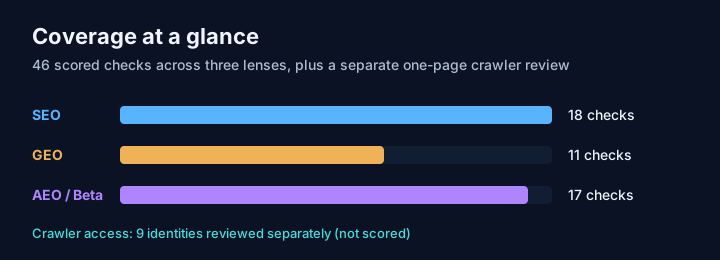
According to the product design, the visibility audit and the ad scanner answer different questions with different evidence. The audit reads one public URL against 46 checks across SEO, GEO, and AEO Readiness — Beta, following Google SEO Starter Guide fundamentals and Stanford information-retrieval research. The scanner reads submitted copy against platform policy patterns. One product reviews the page, the other reviews the words, and neither predicts what a platform or answer engine will decide.
What should a new team read first?+
Start with the methodology pages, which document how every check works and what each finding means. According to the docs structure, the visibility methodology covers the 46 page checks and the compliance methodology covers the 65 ad detectors. Then run a free scan or audit on a real page, read the findings with their evidence, and use the glossary for any unfamiliar term. The key takeaways on each page state what to fix first.
How does Optimus Pass handle data privacy?+
According to the privacy policy, Optimus Pass minimizes data exposure by design. Scans and visibility audits require a verified account and save reports to your account so you can revisit them; the landing-page audit also offers a limited anonymous preview that is processed in memory and discarded after the response. Billing runs through Stripe, ad-account credentials are never collected, and customer data is never sold. Optional measurement pixels load only after explicit consent.
What does the product roadmap prioritize?+
According to the operating principles, accuracy ships before features, so the roadmap prioritizes detector precision and evidence quality over new surfaces. The 65 ad detectors and 46 page checks are updated as platform policies and enforcement signals change. New capabilities, such as the coming Agency Pro tier, ship only when the workflow behind them is ready rather than on a marketing calendar.
How can agencies use Optimus Pass with clients?+
The Agency tier has 250 checks per month and multi-client organization, so agencies can run scans per client and share limited public report views that expire on a stated date. The $1,995 done-for-you audit adds a human-reviewed prioritized fix plan. It groups related findings into tasks, suggests an owner for each, and defines what done looks like. Delivery is within 3-5 business days after the completed intake.
What does the review process look like end to end?+
According to the product design, the workflow runs scan, interpret, fix, and re-scan. First the engine reports observed conditions with evidence across 65 ad detectors or 46 page checks. Then the findings are prioritized so the highest-risk item comes first. After the implementer makes the change, a re-scan of the same input confirms what resolved. Each cycle is point-in-time, and no step promises approval, ranking, or citations.