
Platform · Two products
See what search engines can read — and what your ad copy might trigger.
Visibility is the primary product: SEO, GEO and AEO Readiness — Beta checks on one public page, plus a separate crawler review. Ad Compliance is the second: 65 risk detectors across 10 platform profiles for the copy you submit.
By Grady Coleman (Founder) · Last updated:
What should you know first? Key takeaways
- 65 risk detectors (25 keyword, 40 pattern) across 10 bounded platform profiles for ad-copy review.
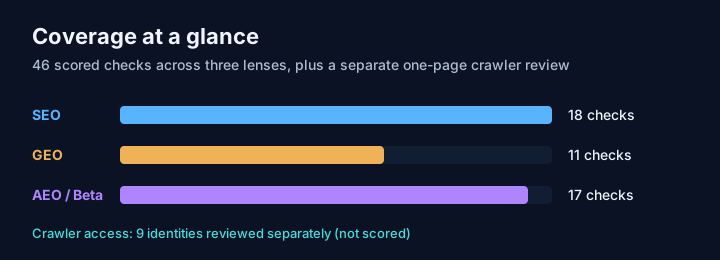
- 46 page checks across SEO (18), GEO (11), and AEO Readiness — Beta (17) for visibility diagnostics.
- Every finding carries matched evidence with severity, and rewrites are re-checked before display.
- No feature predicts approval, ranking, or citation; all output is directional review aid.
How do the visibility checkers work?
One scan measures four visibility signals across SEO, GEO, AEO Readiness — Beta, and crawler access, each reported separately with evidence.
SEO Checker
18 on-page visibility checks including title tags, meta descriptions, heading structure, alt text, and internal links. This is a defined diagnostic, not coverage of every Google ranking signal.
GEO Checker
11 checks for AI Overview readiness signals, including extractable answer blocks, question headings, citations, and fact density. These checks do not guarantee inclusion or citation.
AEO Readiness — Beta
17 checks on measurable answer-readiness signals — FAQ schema, question headings, named authors, freshness, and source references. Beta scores are still being calibrated and do not predict AI citations, rankings, inclusion, or traffic.
What does the ad compliance engine check?
65 risk detectors across 10 supported platforms — Meta, Google Ads, TikTok, LinkedIn, X, Reddit, Etsy, CTV, Broadcast, and OpenAI.
Scans for banned terms, claim patterns, and regulated language across clinical, medical, and disease-claim categories. Works across Meta, Google, TikTok, LinkedIn, X, Reddit, Etsy, CTV, Broadcast, and OpenAI.
Catches the stuff keyword scanners miss — implied outcome arcs, transformation claims, and personal-attribute framing. Even when every single word is technically allowed, the story your ad tells can still raise review flags.
A 0-100 risk review based on what your ad says, how it says it, and which platform it's headed to. Higher means more detected risk. Not a pass/fail guarantee — just a clear picture of where the risk is hiding.
Lower-risk wording suggestions are provided when a responsible alternative can be generated. Each suggestion is checked again before being shown, and suppressed when a high-risk or prohibited claim remains — swap it in and rescan to review the updated result.
Meta, Google, TikTok, LinkedIn, X, Reddit, Etsy, CTV, Broadcast, and OpenAI. Check your copy against every platform from one place instead of juggling ten policy pages.
Scans your landing page for the same risky patterns your ad might trigger — testimonials, side-by-side framing, outcome timelines, and prohibited supplement wording — and reports HTTP reachability plus robots.txt rules for AdsBot-Google and OAI-AdsBot.
No ad-account connection needed. Scans require a verified account and save review metadata plus a content hash to your history; the landing-page audit also offers a limited anonymous preview that is processed in memory and discarded after the response.
Risk detectors are reviewed as confirmed policy changes are identified. Check the platform's current policies before submission; automated review is not exhaustive coverage.
What do people ask about these features?
How do the 65 risk detectors work?+
According to the product design, the 65 detectors split into 25 keyword detectors and 40 pattern detectors. Keyword detectors match banned terms and regulated phrases directly, while pattern detectors read narrative structure such as implied outcome arcs and transformation claims. Every scan runs the full set against the selected platform profile, and each finding cites the matched wording so the result is inspectable rather than a black-box number.
What do the visibility checkers measure?+
According to the methodology, the visibility engine runs 46 checks across three lenses: 18 SEO checks for on-page fundamentals, 11 GEO checks for AI-search readiness signals, and 17 AEO Readiness — Beta checks for answer-oriented structure. Each check reports an observed page condition with evidence, and the three scores stay separate because search discovery, generative reuse, and answer extraction are different questions.
How is this different from a general AI chatbot?+
According to the product positioning, a general chatbot drafts fluent copy with no notion of review risk, while Optimus Pass measures submitted text against declared detectors and bounded platform profiles. Compared with prompting a chatbot for advice, the product returns scored findings with matched evidence and lower-risk rewrites that are re-checked before display. The two are complements: draft anywhere, review here before submitting.
Do the features guarantee approval or rankings?+
No. According to the product terms, every feature on this page is a review aid. The compliance score describes detected risk rather than predicting approval, and the visibility scores describe readiness rather than predicting ranking or citation. A clear result means fewer known risks, nothing more, and platform decisions remain entirely with the platforms and answer engines.
Which plan includes which features?+
According to the plan terms, the Free plan runs the public ad-copy scanner with 3 lifetime checks, Professional adds 50 checks per month with landing-page audits and the full SEO, GEO, and AEO readiness workflow for one brand, and Agency adds 250 checks per month with multi-client organization. The done-for-you audit at $1,995 exists separately for teams that want a human-reviewed deliverable.
How do teams verify a finding independently?+
According to the methodology, every finding carries the matched wording, the risk category, a severity, and the reason it matters, so any team member can check it without trusting a number. The Meta Advertising Standards, Google Ads policies, and FTC advertising guidance are linked from the references for independent review. Founder Grady Coleman designed the evidence contract so strategists, implementers, and clients all read the same documented condition.
What should a team do after reading this page?+
According to the product design, the next step depends on the question: paste ad copy into the scanner for wording risk, or submit one public URL to the visibility audit for page readiness. Both return prioritized findings with evidence in seconds. The Stanford information-retrieval research and the ACM hallucination survey linked below explain why structured, sourced content performs better in answer engines.
Where is feature development heading next?+
According to the operating principles, accuracy ships before features, so detector precision and evidence quality lead the roadmap. The 65 ad detectors and 46 page checks are updated as platform policies change across Meta, Google, TikTok, and OpenAI Ads. New capabilities ship only when the workflow behind them is ready, and every addition must keep its evidence contract intact.
How do new detectors get added?+
According to the product process, a new detector starts as a confirmed pattern from platform documentation or repeated enforcement appeals. The pattern is scoped to the platforms it affects, tested against real copy, and shipped with its evidence contract intact. The policy-updates page records each addition with its date and source.
How do the two engines compare?
Compared with a single-purpose scanner, which answers one question, Optimus Pass pairs two engines that answer different ones. According to the product design, the ad engine reads submitted wording against platform policy patterns from Meta, Google, TikTok, and seven other profiles, while the visibility engine reads one public URL against documented search fundamentals from Google and Stanford research. Founder Grady Coleman built both around the same contract: observed evidence with every finding, and no prediction of platform decisions.
| Aspect | Ad compliance engine | Visibility engine |
|---|---|---|
| Input | Pasted ad copy | One public URL |
| Checks | 65 detectors, 10 profiles | 46 checks, 3 lenses |
| Evidence | Matched wording + rewrites | Observed conditions + fixes |
| Guarantee | None, by design | None, by design |
Which sources support these features?
Each reference below is public documentation or research, cited so the features above are verifiable rather than asserted. According to the published guidance, platform behavior remains a platform decision. A reference is not an endorsement of Optimus Pass.